Early 2026
The Build-Out
The data-centre construction boom is in full swing. Hyperscalers, valuing the prospect of AGI in the hundreds of trillions of dollars, operate on a winner-takes-most logic: whoever scales compute fastest wins everything. Their priority is speed-to-power — getting megawatts online quickly — not sustainability or efficiency.4
But IT equipment turns obsolete in four to six years, so every new centre being planned is a bet that demand will arrive before the infrastructure depreciates. Analysts warn of an acute risk of overbuilding, destroying private capital and leaving society with significant physical waste if the demand curve disappoints.12
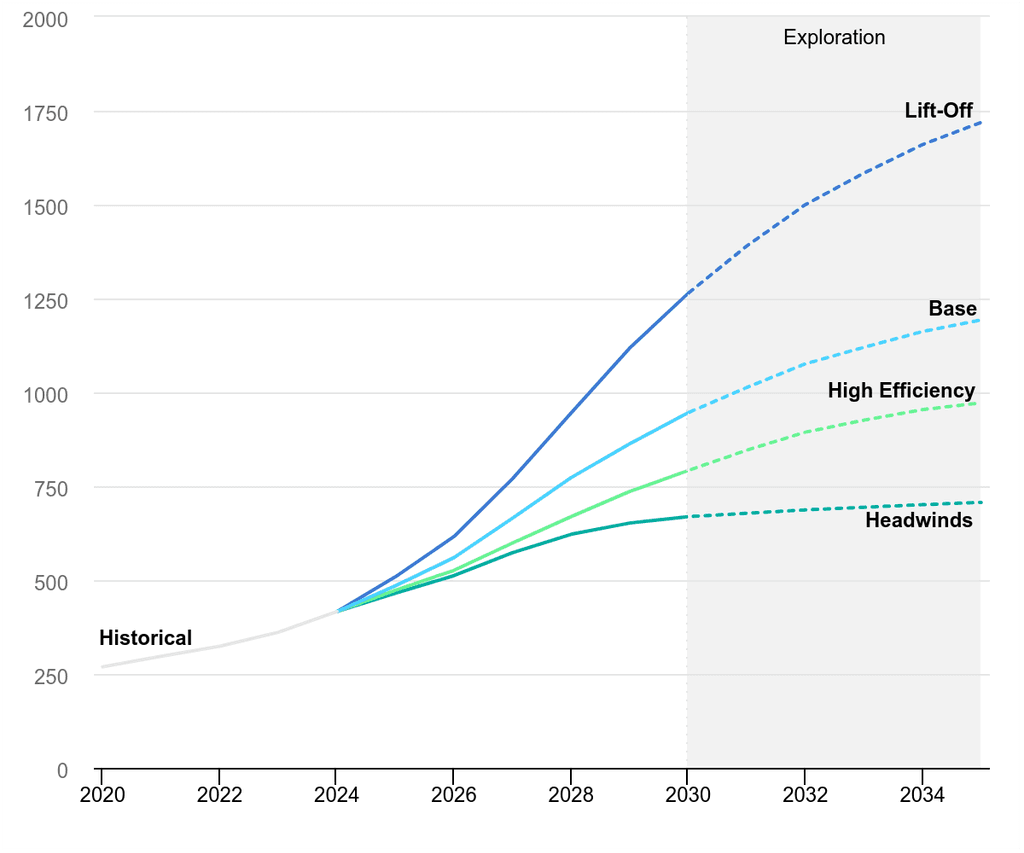
The demand curve might, after all, disappoint. Multiple observers argue the headline projections are exaggerated.34 The CEO of Constellation Energy, one of the US’s largest independent power producers, cautioned investors on a 2025 earnings call that the industry has ‘a history of over forecasting’ demand.5 The IEA’s own outlook spans multiple sensitivity cases; an indication of how little anyone knows.6
Meanwhile, the ecosystem is fragmented. Founders, big tech, energy experts, and investors each assume someone else owns the externalities. At the earliest investment stages, sustainability isn’t seen as sufficiently ‘material’ yet. A gulf separates the exponential-curve thinkers from the people who work with physical constraints for a living.
Mid 2026
Physical and Political Constraints
Physical constraints begin to surface. Because AI’s anticipated growth curve is steeper than the grid’s, clean power, transmission capacity, and transformers are diverted to data centres — potentially slowing decarbonisation everywhere else.7 The Netherlands, Singapore, and other jurisdictions maintain de facto moratoria on new data centres, their grids too congested to take more.8
Demand will be met with dirty power: BloombergNEF projects roughly 64% of incremental data-centre energy demand will come from fossil fuels, with the lifespans of existing coal and gas plants quietly extended.9 Capital earmarked for clean energy is redirected — the UAE’s primary renewable energy firm, Masdar, recently shifted billions of dollars from planned green hydrogen projects to artificial intelligence and data centre infrastructure.10
Locally, the strain is increasingly felt, and the backlash becoming political. Consumer electricity bills rise notably in Maryland, Virginia, and Oregon; residents push back and officials feel the pressure, while US utilities scramble to make tech firms pay their fair share of infrastructure costs.11
Transparency norms are forming, though. The EU AI Act mandates energy-efficiency disclosure for models.24 Salesforce — with Hugging Face, Cohere, and Carnegie Mellon — releases an AI Energy Score benchmarking models on a 1–5 scale, and commits to disclosing energy data for its own proprietary models.13 The measurement infrastructure for a different path now exists.
Mid 2027 · Branch point
Where, Then, Do We Go From Here?
Two possible futures follow; a best case, and a worst case. Choose one to read first.
Late 2027
The Race Continues
Geopolitical competition settles the argument in favour of ever-larger, more complex models. There is little momentum for greening the AI stack, and data-centre energy demand grows unabated. Speed-to-power wins every decision.9
2028
Backlash Mounts
Consumer electricity bills skyrocket in data-centre regions.11 Discharge and contamination of potable water worsen; droughts arrive more often and hit harder. Local water-quality indicators — temperature, pH, total dissolved solids, conductivity — plummet near clusters of compute.12
Sociopolitical backlash foments. Critical media coverage moves from the business pages to the front page; sentiment analysis of headlines trends steadily negative. Legislative and regulatory activity escalates — hearings, draft bills, town halls — but fails to materialise into binding law.
2030
Two Ways Down
From here the negative trajectory diverges again, depending on whether AI adoption succeeds commercially. Both sub-paths end badly for the climate — through different mechanisms.
Future IA · Adoption succeeds
The Rebound
AI developers crack value realisation at scale, by prioritising the development of trustworthy systems. Enterprises and consumers adopt AI en masse, and energy-efficiency bottlenecks are engineered away.
But every efficiency gain is swamped by the explosion in total consumption. The climate problem worsens despite optimisation.
The social effects of rapid AI diffusion are rising unemployment and inequality to unprecedented levels. Societal consensus frays, and democratic institutions weaken. The political coalition behind climate action erodes just when it is needed most.14
As deployment scales, consumer electricity bills rise while drought frequency, intensity, and local water quality near data centres deteriorate.
There is a significant opportunity cost racking up: years and capital sunk into underperforming AI-climate bets, while emissions from every other source keep climbing. The full weight of these consequences, which are nothing short of catastrophic, will not be felt within this scenario’s timeframe — but they compound quietly, and will be reckoned with later on.
Future IB · Adoption stalls
The Stall
Alternatively, value realisation never arrives. Energy-supply bottlenecks persist, doubts about AI’s trustworthiness remain, and adoption falters. The public — deeply distrustful of AI systems, especially with personal data — never embraces consumer-facing climate-beneficial applications, which fail to scale.15 The resource costs of the build-out have been paid, but the climate benefits never materialise.
It becomes obvious that there has been an overbuilding of data centres. Many that have been built sit at low utilisation rates, and it is not clear that they can be repurposed. Ongoing building projects are halted. Major investments are wasted and unneeded fuel infrastructure becomes stranded.12
Technology company valuations, including those of hyperscalers, specialised AI firms, and chip manufacturers, undergo drastic corrections overnight. This reverberates across the global economy and inflicts major capital losses.
Inequality and populism are on the rise, and public and political discourse becomes dominated by the economic crisis, pushing climate change down the list of priorities. The erosion of capital in VC, PE, and also in public finances dramatically reduces the appetite for funding climate change solutions.
2032 → 2035
The Hot Decade
In both of the above sub-paths, investors have chronically underfunded frontier climate innovation. The efficiency gains that AI did deliver show up more in oil-and-gas prospecting than in climate solutions. Fossil plants brought online for short-term data-centre demand keep running.
Global CO₂ emissions rise beyond previous forecasts. Temperatures climb, greenhouse-gas concentrations increase, and extreme weather grows in frequency and intensity. Food security declines and populations are displaced, with profound societal and economic consequences.
Late 2027
Pricing the Externality
In our best case scenario, the largest energy- and water-intensive models face regulatory scrutiny, reputational risk, and procurement barriers: enterprise B2B customers, wanting lower compute bills anyway, start requiring sustainability metrics in contracts. Greener AI becomes cheaper, and then becomes table stakes.
Capital allocation shifts up the chain. Asset owners press fund managers with specific, non-negotiable environmental governance questions. VCs, in turn, push founders toward a ‘full system approach’ from the earliest stages of development.
2028
Measurement Becomes Market Practice
The AI Energy Score matures from a benchmark into a de facto procurement standard, with major labs disclosing under the EU AI Act’s efficiency provisions.13 Asset owners go beyond screening: they create dedicated funds and allocations that shift VC incentives and de-risk climate-positive AI investment, balancing their own climate exposure with climate-technology upside.
Money flows into energy- and water-efficient AI infrastructure — clean-energy data centres, waste-heat reuse feeding district heating networks that displace fossil boilers in surrounding neighbourhoods.21 Momentum builds for climate-positive AI use-cases, because for the first time they are cheaper to fund than to ignore.
2029 → 2031
Climate-Beneficial Applications Take Hold
With the stack greening, attention turns to what AI can do for the transition. Climate-positive AI startups attract high valuations. AI accelerates discovery in catalysts, novel materials, and battery chemistries.16
Small, specialised models — trained on high-quality, localised, or proprietary data in pharmaceuticals, finance, and agricultural measurement — outperform giant generalists on the tasks that matter, while aligning with sustainability and data-protection norms.1819 AI-assisted grid management handles intermittent renewables, onboards data centres faster, and runs them flexibly; training jobs are dynamically scheduled around real-time local weather, and inference is routed to where water is abundant.1220
AI translation and language unification aggregate fractured research across science and policy, accelerating R&D and enabling better modelling of complex futures — and better policymaking.
2032 → 2035
The Lever
By the early 2030s, AI’s pivotal role in reaching net zero is being realised rather than merely projected. The application wave compounds: optimised fuel mixes in cement kilns; route selection and EV adoption cutting vehicle emissions; HVAC control across building complexes; methane-leak detection over oil and gas operations; renewables-heavy grids kept stable and efficient; even protein-property identification improving meat alternatives.22
Data-centre demand still grew — but on a flatter curve, powered cleaner, sited smarter, and repaid many times over in avoided emissions elsewhere.
Summary
The two futures, side by side
The same variables across all three scenarios.
| Variable | Worst case Future IA · adoption succeeds | Worst case Future IB · adoption stalls | Best case Efficiency Push |
|---|---|---|---|
| Investor / VC behaviour |
The AGI-at-all-costs mindset of investors drives accelerated data-centre build-out. Investors underfund climate-beneficial applications for AI. AI’s potential for disruption in frontier climate innovation fails to deliver at scale. |
Push startup founders to monitor energy use across training and inference, benchmark against alternatives, and optimise; small, specialised models adopted where they fit; clean-energy-powered data centres scale. Invest in climate-beneficial applications. Discovery in catalysts, materials, and battery chemistry accelerated; applications target high-impact sectors; AI’s role in reaching net zero is realised. |
|
| Invest in solutions that improve energy efficiency of both AI models and data centres, overcoming bottlenecks. Invest in AI systems that prioritise trustworthiness. | Fail to invest in AI use cases that are trustworthy, and fail to overcome bottlenecks in energy systems. | ||
| Adoption rates and data-centre utilisation |
High. Dramatic increase in AI adoption globally. Data-centre-driven demand rises unabated. |
Much lower than expected, as the general public doesn’t trust AI systems. Many data centres sit unutilised. |
High, but efficiency-led. Enterprise procurement and regulatory scrutiny push adoption toward trusted, high-value use cases, so build-out tracks realised demand rather than running ahead of it. Data centres are highly utilised, increasingly powered by clean energy, and designed for flexibility. |
| Public and societal consequence |
Widespread deployment of AI leads to job loss and displacement. Inequality and polarisation soars. Democratic institutions required for strong climate governance are weakened, as well as public attention on climate. Political progress on climate made to date is undermined. |
Communities near built data centres bear the local costs (water stress, land use, energy diversion) without any benefit, since the promised applications don’t scale. Trust in the tech industry and its claims erodes. Financial stress from the bubble bursting dominates political attention, and the climate gets crowded out of the agenda. |
AI’s role in the economy grows on proven, trusted use cases. Public trust of AI and the tech industry is high. Benefits of AI across the economy and society are realised. |
| Environmental outcome | Consumer electricity bills increase, drought frequency and intensity in areas near data centres increase, and indicators of local water quality plummet. |
Damage from the build-out phase is already locked in, with land cleared, water rights secured, and clean-energy investment diverted. Ongoing impact is lower than Future IA since idle data centres draw less power and water day-to-day, but the environmental cost to build them has been paid. |
AI-driven grid management and dynamic scheduling make renewables integration and water use far more efficient; waste heat is reused (e.g. district heating), cutting local emissions. Efficiency gains are realised rather than negated by rebound effects. |
| Investor consequence | No dramatic correction, but a significant opportunity cost: capital and years lost to underperforming AI-climate bets while emissions keep rising from other sources. | Tech and hyperscaler valuations correct sharply; capital erosion reduces appetite for climate-solution funding across VC, PE, and public finance. | Dedicated funds and de-risked allocations for climate-positive AI open a durable opportunity; startups accelerating net-zero-relevant discovery attract high valuations. Returns compound alongside real climate impact. |
Takeaways for Investors
What can investors do?
The central thesis of this scenario is that AI’s future climate impact is not inevitable. The decision tree remains broad at critical junctures, and it is shaped by innovators and capital allocators. Three areas of the ‘greening the stack’ opportunity remain underfunded:
Software optimisation cuts energy use with substantial cost savings and minimal capability loss.17 Small Language Models need far less compute to train and run, with impressive capability from well-designed architectures — plus better privacy, reduced bias, and relevance in data-scarce emerging markets.1819
AI-assisted handling of complex electricity networks: managing intermittent renewables, onboarding data centres faster, operating them flexibly, scheduling training around local weather, and siting inference for water efficiency.1220
Flexibility, cleaner energy and fuel sources, and waste-heat reuse — district heating that eliminates the need for fossil-fuel heating in surrounding neighbourhoods.21
Six practical actions
- Measure the portfolio. Collect and monitor energy consumption, water usage, and carbon intensity across AI holdings; benchmark against industry standards.
- Push the full-system approach early. Energy mix, water impact, and environmental trade-offs against model performance, from the earliest stages.
- Stress-test the infrastructure. Assess data-centre exposure to heat stress, water scarcity, and extreme weather.
- Fund right-sized models. Support SLM development and testing platforms (e.g. Hugging Face’s HuggingChat).
- Watch the sentiment. Monitor public opinion and media coverage of data-centre build-out in key regions — a leading indicator of regulatory and reputational risk.
- Know your own systemic footprint. Understand your organisation’s aptitude for contributing to — or mitigating — systemic risk.
References
- IEEFA (2025), The risk of AI-driven overbuilt infrastructure is real.
- Lovins (2025), Data centers, AI, and demand response (Stanford, PDF).
- Man Group (2026), The AI bubble.
- McKinsey (2025), The cost of compute: a $7 trillion race to scale data centers.
- Constellation Energy Q1 2025 earnings-call transcript (Joseph Dominguez remarks).
- IEA (2025), Global data centre electricity consumption by sensitivity case, 2020–2035.
- Hiller & Ramkumar (2024), Big tech is rushing to find clean power to fuel AI’s insatiable appetite, WSJ.
- Wilson, Fan & Amanta (2025), Oxford Energy Forum: AI & energy (PDF).
- BloombergNEF, New Energy Outlook.
- Ratcliffe & Paola (2025), UAE’s renewables champion shifts hydrogen billions to data boom, Bloomberg.
- Saul et al. (2025), AI data centers and electricity prices, Bloomberg Graphics.
- Li et al. (2025), Making AI less thirsty, ACM.
- Salesforce (2025), AI Energy Score (with Hugging Face, Cohere, Carnegie Mellon).
- Amanta & Wilson (2025), The overlooked climate risks of artificial intelligence, Oxford Energy Day.
- Vrain & Wilson (2025), Data concerns undermine AI applications for climate.
- Wilson, Fan & Amanta (2025), Oxford Energy Forum 145 (PDF).
- Frugal AI Hub (2026), frugalai.org.
- Belcak et al. (2025), Small language models are the future of agentic AI, arXiv.
- Nanni et al. (2025), Why we still need small language models, even in the age of frontier AI, Alan Turing Institute.
- IEA (2025), Energy and AI.
- World Economic Forum (2025), 6 ways data centres can cut emissions.
- Stern et al. (2025), AI and climate, npj Climate Action.
- Reframe Venture (2026), Scenario I: Energy / Water — the original analysis this timeline adapts.
- White & Case, Energy efficiency requirements under the EU AI Act.
Participants and reviewers
We are grateful to the participants of the workshop and reviewers of this report, listed below. Their inclusion here reflects their contribution to the workshop discussions and the review of this piece, and does not imply endorsement of any specific conclusions of our analysis.
Participants and reviewers included Natasha McCarthy, Associate Director at the National Engineering Policy Centre, Royal Academy of Engineering; Professor Gina Neff, Executive Director at the Minderoo Centre for Technology and Democracy, University of Cambridge; Professor Charlie Wilson, Professor of Energy and Climate Change at the Environmental Change Institute, University of Oxford; Sophie Walker, Senior Advisor and Investment Committee member at EQT Partners; Albert Howard, Head of Research and Investor at Revent; Louis Millon, Investment Principal at Systemiq Capital; Sabrina Iavarone, Sustainability Manager at the British Business Bank; and Alice Birch, Investment Manager at Better Society Capital.